From Tolstoy to Tinker Bell, Down from Berkeley to Carmel

In the news, IBM is retiring old OSI-approved licenses and consolidating around the Eclipse Public License.   Good for them.  People who are running open source projects tend not to want to become legal experts, after all.   There is a contrary point of view, of course, that license proliferation is not such a problem as the best (favoured, admired, desired) licenses will be used more frequently and become the most well known.   The estimable Stephen O’Grady of RedMonk raises good points about the need not to get one’s knickers in a twist about the large number of open source licenses that exist – Occam’s soothing balm, if you will.

And yet, and yet, I don’t necessarily hold that the FLOSS crowd is always so wise in its license choices.  Specifically, I do not think that one should conclude that the slow uptake of the Gnu Affero General Public License (AGPL) means that the concerns it seeks to address are not important ones to FLOSS developers – to wit, closing the web service “loophole”, where those delivering a service using software that is distributed under a strong copyleft are not obliged to share any modifications they make in order to offer that service.

There was no better illustration of the debate than the Eben Moglen – Tim O’Reilly set-to at OSCON in 2007.  Briefly, Mr O’Reilly asserts that open source licenses are no longer relevant in a webservice world.  Mr Moglen said, (from memory), that Web 2.0 was “just thermal noise”, i.e. unimportant, compared to the wider question of Free Software.  And this is my point: one of these gentlemen will be right, one wrong, and many people are influenced by the thinking of both of them, embracing a contradiction.

On the one hand, the Free Software “funamentalists” are very clear in what constitues freedom: it is the rights that they are afforded with respect to software that runs on a computer that they own.  And suddenly, the “fundamentalists” seem quite modest in their ambitions – reasonable, even.  Richard Stallman doesn’t seem to care about what Google does with Linux code, because he is not interested in using the “trap” of cloud computing.  He is now becoming interested in the “Javascript Trap” (another Sun trademark being used with a non-approved noun, one suspects), but the Free Software movement’s relationship with webservices remains essentially orthogonal.

Many people in the the open source world, however, are more concerned with promoting successful collaborative creation, and are concerned about what impact the webservice loophole will have on what we might call the “open source incentive model”.   That is because this is what open source is – it is a codification of Free Software princples aimed at stimulating collaborative software development.  This does not mean that open source is either inherently capitalist, as Matt Asay is prone to argue, nor inherently socialist, as the straw man that Matt Asay attacked (did not) argue.

Now, the problem is this: many people in the Open Source community are influenced by the thinking of the Free Software community, and have a tendency to follow it, while distancing themselves from the “fundamentalism” (which is, of course, no such thing, it is simply that something is free or it is not, while a program may contain open and closed components, hence, there are gradations of open source).  But the Free Software movement has less to say about the issue of webservices than the Open Source movement might do.   There is, in a sense, a vacuum of philosophical leadership.

To make matters worse, license choices are havily influenced by previous license choices.  The GPL remains extraordinarily popular: heck, the GPL v2 remains extraordinarily popular.  People do not want to get into complex territory of compatibility issues, and they understand that the GPL has a stirling reputation.  What’s more, when making license choices, developers will be concerned with the welfare of their own project (and rightly so).  And so, I find it hard to argue that the aggregation license choices in favour of strong copyleft licenses which do not close the webservice loophole means that the loophole is not a serious and present concern.

At FOSDEM this year, Mark Surman gave a talk on what Free means in the context of cloud computing (if anyone has a link to a video, please let me know).  I understand that it did not generate a great deal of debate, possibly because we do not yet have a collective understanding of what the issues are.  In my view, it’s high time we start to develop one.

links for 2009-04-16

8-10 blows lasting one second only

Spring has sprung at Tuna Park: witness the frequent and sharp bursts of drumming woodpeckers from dawn til dusk.  We are blessed with just about every variety of woodpecker I have heard of, those of us lucky enough to live in this crisp, clean part of Europe.  I have seen the quite unmistakeable black woodpecker a little further north from here, and last weekend I heard the equally unmistakeable laughter (or yaffle, if you prefer) of the iconic green woodpecker.

But this morning, the drumming was a little harsher than usual.   And although he may be merely a humble greater spotted, he was still posing proudly atop the lamppost outside our house -that is, when he wasn’t beating the hell out of it with his head.

flackstavagen

Dendropocus major, the greater spotted woodpecker, or locally, större hackspett, telling the world that Tuna Park is his territory.  (And we know he’s a he: note the flash of red on the nape of the neck).

woodpecker1

links for 2009-04-09

Human and playful and friendly

I see that the Symbian Foundation’s new logo has taken a mauling on several blogs and in the trade press.  I enjoy Andrew Orlowski’s pieces in The Register.  I’d go so far as to describe him as my favourite at El Reg, certainly since the departure of Ashlee Vance.   But like many of an intellectual bent, he is dismissive of branding.

The question people wrongly ask themselves when they consider a brand is, “do I like it?”.  This is especially true of things that one is already emotionally invested in, such as football teams and, eh, open source projects.  The real question is, “what kind of experience is this suggestive of?”.   So, what do we think?

symbian_aspie_logo

Well, I think that the Symbian Foundation are to be congratulated.  Their new brand is, as they claim, human and playful and friendly.  It is highly distinctive and yet it feels instantly familiar.  This makes it memorable and, yes, it gives the project an identity.  And from a practical point of view, the logo is easily portable – especially important considering where Symbian plays.

People love to take pot-shots at a branding that takes risks.  But great branding is seldom uncontroversial (which is not to say that taste and ethics should not be important considerations – of course they should).  It is easy to have a logo that conforms, that is a nice piece of graphic design, but that challenges nothing.  However, to have a logo that looks a little out of place, that jars, that challenges the very behaviour of the people who it represents – it takes nerve and it takes imagination.  I think that Symbian has done an excellent job of daring to be different with this logo.

Accelerators for Firefox

In all the reviews I have read of IE8 (and I read a lot of them), the feature that most IE8 testers seem to like are “Accelerators”, (i.e. context menus for web services).   Indeed, the estimable Jack Schofield seemed to like the feature, describing IE8 as helping “get stuff done” and having innovative features “not found elsewhere”.

Of course, that most fertile of jungles the Mozilla Add-ons community has an answer for Accelerators, or indeed, three of them: IE8 Activities for Firefox, Kallout, and Select-n-Go.  So far, I have tried Kallout, and mighty fine it was too.  Just as I suspect that Accelerators are a way for Microsoft to make its own (and other) web services more accessible, there is a conceivable opportunity for Add-On developers to offer any number of online services a customisation to make their service more accessible to the (burgeoning) Firefox user base.

One more observation: at least one other Mozilla employee in Eskilstuna remarked upon my own use of context menus for shortcuts as “epic” (and not in a good way).  But he might be right about my right clicking.  It does imply a huge bottleneck in the interface, one that Ubiquity seems ideally positioned to fix.  Anyone that likes Accelerators really ought to give that a spin.

links for 2009-03-31

  • Strange review of different browsers, this. PC World tests IE and Firefox GA versions against Chrome and Safari Beta versions for speed, and then concludes that speed is not important, but that safety is. So, why test Betas then?
    (tags: firefox)
  • “Chrome sucks web pages off the Internet like an Electrolux. So does Firefox. In this test I haven’t managed to separate them significantly.” More on browser performance from Eskilstuna’s own David Naylor: Firefox 3.1 beta 3 is extremely fast. When you forget about performance, you probably have good performance.
    (tags: firefox)
  • “Mozilla originally promised a browser update by Wednesday (1 April) but, in a pleasing departure for standard software development cycles, ended up pushing out the revamp several days ahead of schedule” Very gracious from The Register, and yes, folks were burning the midnight oil inside Mozilla to get this done. I actually saw this reported elsewhere as an attempt by Mozilla to bury news, by pushing out the fix on a weekend. Riiiight.
  • Interesting piece: Firefox’s memory usage much lower than other browsers. As David Tenser often tells me, the relationship between reality and user perception is not always a direct one.
    (tags: firefox ie8)

“Ich bin ein Berliner! If you can’t be on the scene, get it on the screen!” – Don King

You can follow Don’s advice by visiting the Mozilla Add-On Workshop mashup page, and hopefully videos of all presentations will be available before long.

Yup, I’m back from the Mozilla Add-On Workshop (MAOW) in Berlin, and recovered from my 11 hour journey home. A special mention must go to the baggage handlers at Stockholm Arlanda airport whose heroic efforts allowed me to savour an unexpected 3 hour addition to my journey: my luggage’s progress from plane to collection belt vividly evoking, as it did, the great glacial movements that helped to sculpt this fine peninsula.

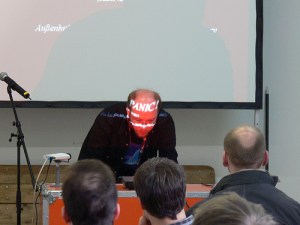
My own contribution to the MAOW was probably summed up by this sympathetic portrait of community legend KaiRo, attempting to get his presentation to work:

kairo

The one talk where I would like to have contributed more was probably Daniel Glazman‘s on making money with add-ons. Without rehashing all the talk, Daniel was essentially proposing that addons.mozilla.org (AMO) needs a system for micro-payments (he was proposing around $1 / download I recall), so that add-on developers can charge for their works.  I should make it absolutely clear that I am not part of the AMO organisation, and I should also make it clear that Rey Bango, who is, is totally committed to enabling whatever makes sense for add-on developers.

But still, my personal opinion is that such a micro-payment system is not a recipe for success for developers, users, or Mozilla as a whole. Firstly, today there is no truly widespread payment system that users will easy use for 1-click purchasing on a new install of Firefox. Requiring registration to a payment service before a user can fully use AMO seems an uncomfortable arrangement to me.

Secondly, how would you price such software? Daniel was suggesting a figure of $1 for a good add-on. I would estimate that even in the affluent west, that is already enough to make many users search further to find something of approximate functionality, and that pricing would need to be much, much lower to ensure clicks (if such a system even existed). Moreover, for the many Firefox users in the developing world, $1 is not a micro payment.  And there is a great wealth of add-ons today (over 4,000, soon to hit 5,000). As Daniel pointed out, if you area not near to the top of a search, you might be invisible. However, if you are successful in achieving visibility for your add-on, pay-for-play immediately incentivises the user to search further if their first results.

Thirdly, how are you going to compete? If you are producing open source add-ons, any add-on which achieved traction would be subject to forking. We would probably need to be talking about closed-source add-ons. And this would inevitable need some license key mechanism, as Daniel indicated. Again, uncomfortable.

Fourth, what kind of license would you be selling? How committed would a developer have to be to forward compatibility to sell and add-on?

Now, all these questions can all be answered to a greater or lesser state of satisfaction, but the likelihood of gouging a successful business out of such an arrangement seems pretty thin to me. Let us consider two perspectives.

One, every business today which relies upon charging for access to something which has no marginal (or opportunity) cost of unit production (software, music, information in general) is facing a challenge in the face of the network – rightly or wrongly, long established businesses which are charging for access are in difficulty. The App Store on the iPhone may buck this trend, but it does not invalidate it. The Internet is eroding all of these business models, even the ability of television networks to command exclusive audiences for sporting events (to Don King’s dismay, one presumes).

Two: software is not intrinsically valuable, not in monetary terms. Anyone who has attempted to rate the value of software using the COCOMO methodology realises this. Software’s value is a function of its usage. If one placed market values on Windows, UNIX, Linux and Mac OS X, their relative values would not have a direct relationship to the quality of code, but to the profile of their usage.

So, how do we make money with software? Well, we should consider what you can monetise software against, and a good rule of thumb is to monetise against something that does have an (implicit) cost of unit production. If you want to make money with software, charging the user for a copy implies either a heavily locked-down system (as Daniel suggested in his talk), an entrenched market position (such as the ability to have software bundled), or both.

But there are other ways to make money from software. In most cases, I would suggest we might think of a way to offer access to a service via an add-on. Allowing users the benefit of particular running infrastructure over time clearly has an associated cost that they may be inclined to pay for. Many free services (Gmail, Twitter) even allow such access for free, and make money by displaying adverts to users (in the case of Gmail) or by raising capital by the sheer promise offered by millions upon millions of users (in the case of Twitter). Twitter does not yet have a clear business model, after all, but you can bet that Jack Dorsey has done alright. In these straightened times, VC opportunites may be fewer and further between – but there certainly are many other online commercial opportunities that do exist and could capture more market share with add-ons.  Considering an add-on like CoolIris, I can imagine being certified compatible with the add-on would be worth money to those sites whose value is based on offering up image-content.

And so I do not agree with the advice that add-on developers should attempt to build something cool or, in the parlance of our times, “shiny”, and then try to make money by selling access, at least, not if they want to earn a good living. The result may be the coolest piece of software that no one has ever heard of. And let us not forget the power and influence of those that scratch their own itch, or even those great souls who enjoy scratching the itches of others. Freely available software will always command a consumer’s preference in an open system.

I hope we can have a good debate about what developers need from AMO, and those who wish to build, or augment a business using AMO, can get their points across and feel their needs are met, just as those who wish to build free / gratis software hopefully will. A big thanks to Daniel for raising the topic and addressing it so squarely.

I mulled all this over on the way home, until I managed to find somewhere selling English newspapers at which point I needed to switch my attention to controlling the pedantic rage that burns inside with the intensity of a thousand suns. Sadly, I failed. And so I offer this picture. I am sure that Mr Gough’s own writing is most illuminating, but, copy editors note, it is hard to take recommendations from an author seriously when they include incorrect spellings of pronouns.

gough2

Mixed Feelings

I see that the CyberMentors programme made this news on Tuesday.

Talking with my friends at BeatBulliyng about the launch of the CyberMentors programme gives me pause for thought.   They are clearly pretty busy.  But more to the point, they are busy because the CyberMentors programme is fulfilling an important need.  And I can also hear it in their voices that they have heard some pretty tragic and difficult stories.  As Sarah at BeatBullying told me, it cuts two ways.  The more successful, relevant and important the project seems to be, the more there is to be sad about.

At the moment, BeatBullying is trying to recruit members in South East England, because that is where they are able to train CyberMentors.  But I understand that they hope to hold trainings further afield, and maybe make the programme international.  Well, when I say international, it actually already is.  I hear that the CyberMentors site is receiving requests from young victims of bullying from all over Europe, and as far as the Middle East.  It makes you think that many of these youngsters may have had no one to turn to before the programme.

Mozilla is proud to be a CyberMentors partner.  If you are interested in volunteering as a CyberMentor, Mozilla can help pay for your training and background checks: please contact me for more information.

Mozilla and CyberMentors

Earlier this year, a task force at Harvard University issued a report that reassured parents everywhere: the risk to children from online sexual predators, while it may exist, is not as significant as we may fear.  However, the report also contained the more worrying finding that there is another, less sensational, problem which is not as widely acknowledged.  As Cory Doctorow put it:

The Internet is full of bullies, not paedophiles

As a child of the 80s, I can find it hard to remember life before the Internet.  I can certainly remember what it was like to buy a flight, or to look for a book, or not to waste time laughing at Zero Punctuation.  It is harder for me to remember what it was like not to be able to look up virtually any fact at will, and it is harder still to remember how I kept in touch with friends before my relationship with the network was so intimate.  But I am certainly old enough to remember all these things.   Today’s 14-year old is not not, of course, and may wonder how we maintained friendships at all before Facebook and the SMS.  Not to have access to the network in this way would represent a form of social exclusion for many children in developed and developing nations.

Something else I can remember about my own childhood – like most people – is being bullied on occasion.   Happily, also like most people, I only experienced it a little, but I was also aware of children who were subjected to it systematically and over long periods of time.

If asked to name one characteristic of the bully, many people would identify cowardice.  I am not sure that is true, but I am sure that bullies are people with problems.  I am also sure that bullies prefer not to have to face the consequences of their actions.  And thinking about it, it is little surprise that the Internet lends itself to bullying: it offers opportunities for cruelty, but also hiding places and anonymity.  It is high time we thought about responses to bullying on the Internet.

Today, the UK charity BeatBullying launches their CyberMentors programme.  And I am very pleased to say that Mozilla is a CyberMentors partner. The CyberMentors programme is a cyber version of one of BeatBullying’s proven methodologies.  CyberMentors themselves help each other and the victims of cyberbullying and report instances of it, and help monitor social networks and other sites to identify hateful or bullying content.

CyberMentors Logo

How can we get involved?

Mozilla will be doing a few activities with BeatBullying throughout the year. The first is to sponsor 10 members of the Mozilla community (UK only, for now), to become CyberMentors.  Anyone can become a Cybermentor, and there is no need for previous experience of working with children: the only pre-requisite is understand and empathy for those who are experiencing bullying.

What is expected of me, as a CyberMentor?

In order to join the programme, there is a training course and a CRB check (mandatory for anyone over 18) – Mozilla will pay for these.   The induction training day is about 5 hours.  As the training is in London, we will hope to find SE England-based community members first – and over time, the programme will roll out to the rest of the country.   Once you are a qualified CyberMentor, it is expected that you will give at least 2 hours of your time each week over a period of 4 months.

If you are under 25, you will be trained as a senior Cyermentor.  If you are over 25, you will be trained to help “mentor the mentors”, and be a senior coach.

I think that those of us in the Mozilla community have a lot to offer the CyberMentors programme.  We tend to spend a lot of time online, and are probably more experienced that the average person in interacting with others in a virtual community.  What’s more, we care about the Internet, and the place it is.  So, if you are interested to be a CyberMentor and would like to learn more, please contact myself or William Quiviger.  Places are limited – bullies are not.

A Guide To Mozilla Community Marketing

Regular readers of this blog (me, mostly), will recall that last November I came over all George W, with the post Wanted: A Guide To Community Marketing At Mozilla (the dead or alive was implicit).  Three months, roughly 50 litres of coffee, one baby and another apparently failed Liverpool Premier League title attempt later*, we have such a beast: the Mozilla Community Marketing Guide.

The genesis of this idea came from Jane.  When we first met up, she was keen to make it easier for people to get involved with everything we’re doing.  Sure, there is a very vibrant community at SpreadFirefox, the exciting appearance of SpreadThunderbird, (and seriously, spread Thunderbird – I cannot believe the mail clients that some members of my family have been persuaded to use), but if you are passionate about, say, Firefox, and want to get involved, it can be hard to know where to jump in.

Similarly, many people already have well-formed ideas about something they want to do.  We want it to be as easy as possible to find the resources that were available, and to get in touch with other people to make things happen.

And along the way, it’s been great to meet people like Alina, who confirmed to me something else that we need to do: to make Mozilla marketing as “buildable” as we can, so that she can go and do the things she wants to do, and tell her story.  Above all, that is what Mozilla means to me.

So, I am happy that today we’re launching our Community Marketing Guide: a big thanks to everyone who has contributed text, pictures, ideas and, yes, corrected spelling mistakes.  The guide is an attempt to catalogue all of the marketing resources we have, and as such is bound to be incomplete.  But over time we will add to it, and identify what is missing.  Indeed, it should also help us to identify those things that we do not have today but that we want (presentation templates, anyone?).  Please visit the site, and let us know what you think.

*p.s. Don’t give up, it’s only February