Pass It On

Use Firefox?  Care about it, but aren’t the kind of person who files bug reports, or writes code?

Well, Firefox in your country, the survey which they’re already calling “not very onerous or intrusive“, is an opportunity to share what you think of Firefox and what could be done to make it better.   If you speak English, Spanish, Polish, German, Brazilian Portuguese or Indonesian, please take the time to answer a few questions if you care about Firefox, and pass it on to anyone else you know who does.  In fact, please do it even if you do file bug reports or write code…

Firefox’s user advocacy reigns supreme

Inspirational stuff from Cory Doctorow about the importance of Firefox in the face of Google Chrome. I think that those who think Chrome is intended to kill Firefox, or that think that Google will somehow do so inadvertently, underestimate the power of community, and of user advocacy.

That the user is paramount may mean to some the ability to block adverts, to others, increasing their security, and to others, simply changing the appearance of their browser. But when this freedom aggregated across a large proportion of users, it means that the Web remains in some sense literally democratic, that is, governed by the choices of people and not of monopolies or oligarchies. This is, after all, only the beginning.

Foxkeh is his name

I wondered about this chap for a while:


Foxkey

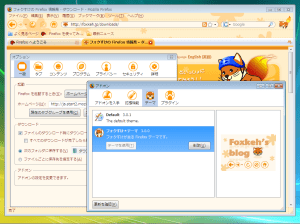
Turns out his name is Foxkeh and he’s the official mascot of (you guessed it) Mozilla Japan. So popular has he become, that you can even, in the parlance of our times, pimp your browser to share in the Foxkeh love. Yes, a Foxkeh theme for Firefox has just been released.

Admit it, you’re similing.

Precious metals

Amazing news on Monday as Manchester City Football Club was suddenly acquired by the Abu Dhabi United Group (ADUG). Who immediately gazumped the previously financially peerless Chelsea to the signing of good-but-not-that-good Brazilian forward Robinho for a British record transfer fee, making the inconsistent Robinho the highest paid player in the history of the game.

The transfer window is now closed, but when it reopens, we are hearing from ADUG that money will be no object as they intend to assemble the best team in the world. The English game has been struggling for a while to accommodate Chelsea, whose financial clout is underwritten by one of the world’s richest men, Roman Abramovich. Chelsea’s sudden weight in the transfer market immediately inflated transfer fees, and queered the pitch for all. To what extent? Well, Chelsea’s losses frequently exceed the turnover of even their closest rivals.

Now Abramovich is understood “to be worth” (curious phrase, that) around $23.5 billion, or about €16 billion. The Abu Dhabi Investment Authority, owners of ADUG, have an estimated wealth of upwards of €800 billion and have signaled their intention to sign just about every top player in Europe, and Critistiano Ronaldo, in the January transfer window.

How do we view investors like Abramovich, and the ADUG? Are they bringing excitement to all, making for a more exciting sport, or are they spoiling it, their unnatural concentrations of wealth making for an uncompetitive and distorted market? Is the game about the people, or about the rich? About the stars, or the grassroots? Clearly the game has changed: a giant with obscure motives and vast wealth has entered the market.

In other news on Monday, Google announced its Chrome browser.

A happy confluence

(Inter)national treasure Stephen Fry talks about the 25th anniversary of the GNU project. Mr Fry is a wonderfully humanising influence (as the number of people who seem to want to appeal to him for personal counselling on his website would testify).

I am hugely sympathy for the Free software movement. Those within (and without) open source who dismiss it as “extremist” would do well to remember just how many visionary and important thinkers have come from outside of the mainstream. No; their apparent radicalism has done us all a great service.

But if I have a difficulty with the Free software movement at all, (and I’m not entirely sure I do), it is that it has occasionally demonstrated a lack of empathy for others. Our freedom is subservient to our underlying humanity, and not the other way around. And so, who better to introduce Free software than the very gentlest of gentlemen?

Curses and the Swedish Loch Ness Monster

I read with interest about the release of the Internet Explorer 8 Beta 2.  I say read because I am unable to download the binary.  It requires Windows Genuine Advantage, and although I most certainly did purchase a license for Windows XP when I bought my PC, that was several years ago, since when the Windows instance went the way of all Windows instances (at least, until Vista), and slowed down to a painful crawl.  I’m the kind of chap who can only stare at a pixelated hourglass for so long, and so in the four years I’ve owned this box, I’ve reinstalled XP twice.  I suspect that this means that my chances of qualifying for Windows Genuine Advantage are slim indeed.   

So instead, I’m reading about IE8 Beta 2.  While comparisons with Firefox 3 do not seem to flatter IE8, it was this piece that really caught my eye.
 

For the web developer community, the biggest news in IE8 is its promise of strict adherence to Internet standards. That’s both a blessing and a curse, it turns out, as some sites that were hand-coded to work with nonstandard behaviors in older IE versions have problems rendering in the default, standards-compliant IE8.

That’s some new, strange meaning of the word curse, surely.  Sounds more like a blessing in disguise to me.  Or if it is a dark cloud, it has the silverest of silver linings.  If Microsoft do manage to deliver on a strict adherence to web standards, they are surely to be heartily congratulated, not cursed.  

In other news, Sweden’s Loch Ness Monster, the Storsjöodjuret (Beast of the Great Lake) was captured on film this week:

…giving the world a partial glimpse of an ancient and terrifying creature.

Invisible Paris

My dad told me that Paris would be deserted in August, and right he was.  Les Parisiennes leave the capital en masse, leaving behind (so Pascal tells me) only those who work in the tourism industry, a grumpy bunch who would also rather be enjoying the crisp waters of the Bay of Biscay and and all points south.  Understandable.   As I look out of my hotel window in the IXe arrondisment, it ought to be bustling, and it isn’t.

But I’m here, meeting my new colleagues at Mozilla Europe, in the top secret Mozilla underground bunker once used by the Scarlet Pimpernel himself*.  This is the week that I started working for Mozilla, and if I’m permitted one deadly sin before breakfast, I’m proud to work for Mozilla.

On arriving at my hotel late on Tuesday night, I put the TV on for some company.   CNN makes a decent enough room-mate, he can be a little dull, and at times rather excitable, but at least we speak the same language.   Brushing my teeth, I half-watched an article about the development of an invisibility suit, which might go into production “in our lifetimes”.  Poppycock?  Possibly not, according to our presenter: after all, 50 years ago, who would have dreamed that we would have a robot on Mars?

The answer is, of course, absolutely everybody.  Most thought we would have men on Mars by 2008.  Heck, in 1975 they thought we’d have have people leaving our solar system by 1999. Had our presenter never heard of Jules Verne, or Isaac Asimov?  In 1958 I would think the consensus would have been that in 50 years’ time we would all be floating around on solar-powered scooters, eating pills instead of food, not suffering from incurable illnesses and generally being pretty space age.  But we’re not.  We’re still fighting wars, driving cars, eating Coco Pops and conspicuously not all swanning around in skin-tight silver suits.

Living memory in 1958 could recall a slew of incredible advances that challenged the imagination and only seemed to be accelerating: pasteurisation, the motor car, powered flight, the jet engine, nuclear fission, space travel – giving rise to incredible expectations.  While for some, it might be hard to remember a world before Twitter, I think it’s also fair to say that the pace of change could never meet the expectations of a half century ago.

Apart from in one area: information and communications technology.  The Internet, and specifically the Web, certainly does match my, and I suspect most other peoples’, childhood imagination of what the future would be like.  Moreover, I think we imagined many qualities about it which are still emerging today: its ubiquity, its unregimented nature, its fundamental openness.  In the late 1990s, there was a campaign at the time called “Any Damn Browser”, which argued (as I recall) for adherence to Web standards.  It failed.  By about 2002 if, like me, you were using a non-Internet Explorer browser, many web pages could fail to work.

Firefox changed that.  Its adherence to standards, customisability and source code have also been one of the chief stimulants to web development since.  Firefox opened the web, and at a time when such an achievement seemed highly unlikely.  We now have a competitive browser market.  And part of my new mission here at Mozilla is to help people in Europe to make a conscious choice for tool they use to participate on the Web, and to help make sure that the variety of choices they currently have endures.

The Web is developing at a bewildering rate right now.  Long may it continue.

* Not entirely true.

The views expressed here are not necessarily those of my former employer

cross-posting to http://blogs.sun.com/patrickf

After 11 years at Sun, I hope you can forgive a little sentimentality as I write my last as a Sun employee. I’ve had a wonderful time here. In the week I joined Sun (SunExpress actually, which although it sounds like a budget travel agency, was in fact an inside sales division), the sales manager who hired me left. Unlike her, I am not making a leaving speech, but were I too, I would say the same thing: it’s all about the people.

I’ve had the opportunity to work with amazing, and more importantly, really good people. Although we may no longer be co-workers, we will still be friends. And happily, we will still be colleagues: I am remaining in the world of free and open source software to work at Mozilla, marketing Firefox in Europe. That such an opportunity was available to me was certainly in part thanks to Sun’s credibility in open source. This is the result of the efforts of hundreds, even thousands, of people at Sun, but of course much of the credit has to go to my boss, Sun’s chief open source officer, Simon Phipps. Simon is a marvelous man, from whom I have learned a great deal, (but I suspect only a fraction of what he could teach me). I literally do not know how he does what he does, and I will miss him.

As for the new waters Sun is charting in open source, I am proud to have had a small part to play in it. And I believe that Sun’s customers and shareholders will have reason to be pleased, even if the ride seems bumpy at times. I like to think that we’ve moved on from regarding Microsoft as ‘evil’. They are no more evil than they are brilliant. It just happens that they’ve been the chief beneficiaries of the IT sector’s natural susceptibility to monopolisation. But by the simple expedient of respecting the freedom of software’s users, we have the potential to avoid both the monopolisation or the fragmentation of the network; to keep the network as an instrument of human empowerment and not one of control, and to accelerate the growth of shared wealth in the form of accumulated learning. I feel very lucky to be able to identify this outcome in my work, in both my old job and my new one.

In my interview to join Sun, the soon-to-leave manager innocently asked why it was that Sun had no customers (or at least, relatively few), in my hometown of Liverpool, which was at the time enduring a bout of post-industrial malaise. I didn’t have a very good answer for her, but it’s nice to reflect that these days, Liverpool is European Capital of Culture (whatever that means, exactly), in Eskilstuna, Sweden, where I now live, there seems to be a higher level of awareness of Liverpool FC than practically any other institution, and even the head of Sun’s sales organisation is a scouser.

Finally, I turn to some advice that I got in my early days on the job, on getting my first account to manage. John, a senior colleague, took me to one side and said to me, “Patrick, this is important. Whatever you do, don’t f*** it up.” So, I am transplanting my blog here where I will endeavour to keep following this sage counsel.